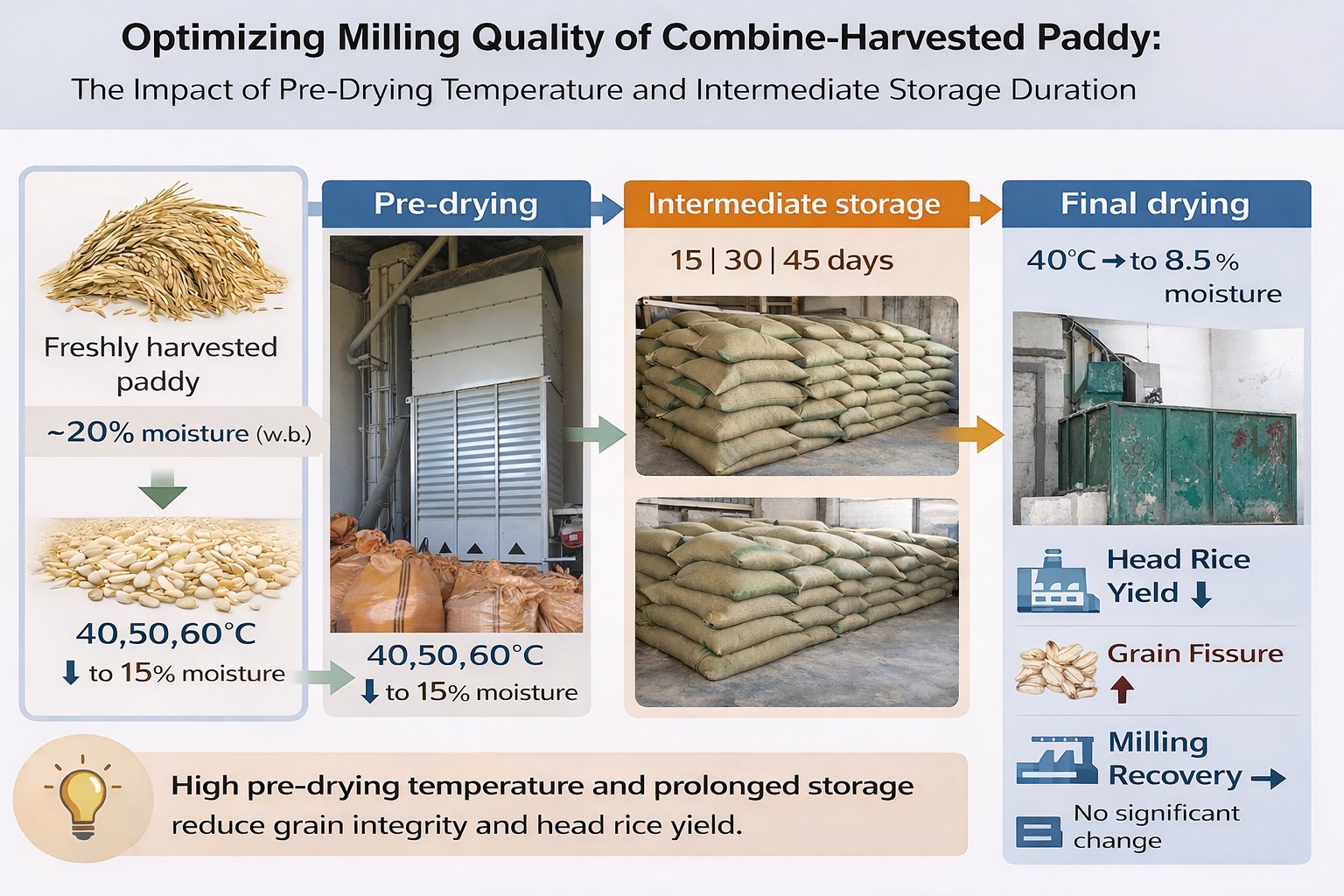
Bunna, S., Sinath, P., Sereyvuth, L.H., Somaly, Y., Chea, S., Ouk, M., Sinh, C., Lina, N., Sreypov, H., Rumduol, Y., Mitchell, J., & Fukai, S. (2018). Fissured grain and head rice yield of crops harvested manually or by combine. Plant Prod. Sci., 22(1), 88–97. https://doi.org/10.1080/1343943X.2018.1538700
Chayjan, R.A., Ghasemi, A., & Sadeghi, M. (2019). Stress fissuring and process duration during rough rice convective drying affected by continuous and stepwise changes in air temperature. Dry. Technol., 37(2), 198-207.
Chupungco, A., Dumayas, E., & Mullen, J. (2008). Two-stage grain drying in the Philippines (ACIAR Report No. 59). Australian Centre for International Agricultural Research.
Cnossen, A.G., Jimenez, M.J., & Siebenmorgen, T.J. (2003). Rice fissuring response to high drying and tempering temperatures. J. Food Eng., 59(1), 61–69.
Dong, R., Lu, Z., Liu, Z., Koide, S., & Cao, W. (2010). Effect of drying and tempering on rice fissuring. J. Food Eng., 97(2), 161–167.
Elepano, A.R., Billate, R.D., & Drahousky, I.B. (2005). Two-stage drying as a different strategy for paddy rice. Phil. J. Crop Sci., 30(1), 3–9.
Hashemi, J., & Shimizu, N. (2008). Investigation of fissure formation during drying of japonica aromatic rice. Int. J. Agric. Biol., 10(2), 179–184.
https://doi.org/ 07–342/MFA/2008/10–2–179–184
Iguaz, A., Rodriguez, M., & Virseda, P. (2006). Influence of handling and processing of rough rice on fissures and head rice yields. J. Food Eng., 77(4), 803–809. https://doi.org/10.1016/j.jfoodeng.2005.08.006
IRRI (International Rice Research Institute). IRRI Knowledge Bank. 2022. URL https://www.knowledgebank.irri.org
Jittanita, W., Srzednicki, G., & Driscoll, R. (2010). Corn, rice, and wheat seed drying by two-stage concept. Dry. Technol., 28(6), 807–815.
Keya, A.C., Hossen, M.A., Al Mamun, M.R., Alim, M.S., Hossain, B., & Baidya, J. (2025). Drying and tempering effect on milling process of paddy in unparboiled condition. Agric. Eng. Int. CIGR J., 27(1), 159–175.
Manna, L., Dutta, A., & Chakraborty, S. (2019). Effect of drying and tempering on head rice yield. J. Food Sci. Technol., 56(10), 4339–4348.
Molina-Hernandez, J.B., Grande-Tovar, C.D., Neri, L., Delgado-Ospina, J., Rinaldi, M., Cordero-Bueso, G.A., & Chaves-López, C. (2025). Enhancing postharvest food safety: the essential role of non-thermal technologies in combating fungal contamination and mycotoxins. Front. Microbiol., 16. 1543716
Nguyen-Van-Hung, Tran-Van-Tuan, Meas, P., Tado, C.J.M., Kyaw, M.A., & Gummert, M. (2018). Best practices for paddy drying: case studies in Vietnam, Cambodia, Philippines, and Myanmar. Plant Prod. Sci., 22(1), 107–118.
Sarkar, M.S.H., Akhtaruzzaman, M., Mondal, M.H.T., Kamal, M.M., & Plabon, E.A. (2022). Evaluation of drying characteristics, milling performance and nutritional quality: The case of aromatic rice. J. Food Process. Preserv., 46, e16275.
Siebenmorgen, T.J., Qin, G. & Jia, C. (2005). Influence of drying on rice fissure formation rates and mechanical strength distributions. American Society of Agricultural and Biological Engineers (ASABE).
Srzednicki, G., & Driscoll, R.H. (2008). Implementation of a two-stage drying system for grain in Asia. In G. L. Robertson & J. R. Lupien (Eds.), Using food science and technology to improve nutrition and promote national development (Chapter 7, pp. 1–14). International Union of Food Science & Technology.
Velupillai, L., & Pandey, J.P. (1990). The impact of fissured rice on mill yields. Cereal Chem., 67(2), 118–124.
Wang, H., Che, G., Wan, L., Chen, Z., Sun, W., & Tang, H. (2023). Effect of variable temperature levels on drying characteristics and quality indices of rice in continuous drying and multi-stage intermittent drying. J. Food Process Eng., 46(7), e14356. https://doi.org/10.1111/jfpe.14356